
Why does my Collection Equipment Need Regular Preventive Maintenance?
Why does my Collection Equipment Need Regular Preventive Maintenance?
In the industrial world, dust collection equipment plays a critical role in maintaining a safe, compliant, and efficient work environment. Whether you are working in metal fabrication, woodworking, food processing, or manufacturing, your dust collector works continuously to remove airborne particles and help keep your facility clean and safe.
But like any hardworking piece of equipment, things happen and the best way to prevent them is through regular care and maintenance. That is where preventive maintenance (PM) comes in.
Why Preventive Maintenance Matters
1. Keeps Your System Running Efficiently
Dust collectors are designed to capture airborne particles before they settle throughout the facility or enter employee breathing zones. Over time, filters can become clogged, fans and motors can wear, and seals can deteriorate. These issues can reduce airflow and make the system less effective, increase energy costs, and cause safety issues for employees or dangerous conditions that lead to secondary explosions. Regular preventive maintenance helps ensure that the major components of your dust collection system are operating as designed.
2. Helps Avoid Costly Downtime
Unexpected equipment failures can bring production to a halt. A malfunctioning dust collection system can also create safety and compliance concerns, particularly when the collection system is essential to controlling hazardous or combustible dust. Preventive maintenance allows potential problems to be identified and addressed before they turn into expensive emergency repairs or unexpected downtime.
3. Extends Equipment Life
Routine inspections and maintenance can help extend the useful life of your dust collection equipment. Cleaning components, replacing worn parts, checking alignment, and addressing small problems before they become major failures can help protect your investment and keep your system operating for years to come.
4. Helps Maintain Regulatory Compliance
OSHA, NFPA, and EPA requirements may apply to different aspects of dust collection, air quality, and combustible dust depending on the facility and application. A poorly maintained dust collection system can create safety and compliance concerns. Regular preventive maintenance, along with proper documentation, can help facilities identify potential issues and maintain their equipment in accordance with applicable requirements.
5. Improves Air Quality and Safety
Clean air is an important part of a safe industrial work environment. Properly maintained dust collection equipment helps control airborne particulate and keeps dust from accumulating throughout the facility.
For facilities that handle combustible dust, maintaining the collection system is also an important part of reducing potential fire and explosion hazards. Dust collection systems should be properly designed, maintained, and evaluated based on the specific material and process.
What Should a Preventive Maintenance Program Include?
A proper preventive maintenance schedule should be based on the type of dust collection equipment, the material being collected, operating conditions, and how frequently the system is used.
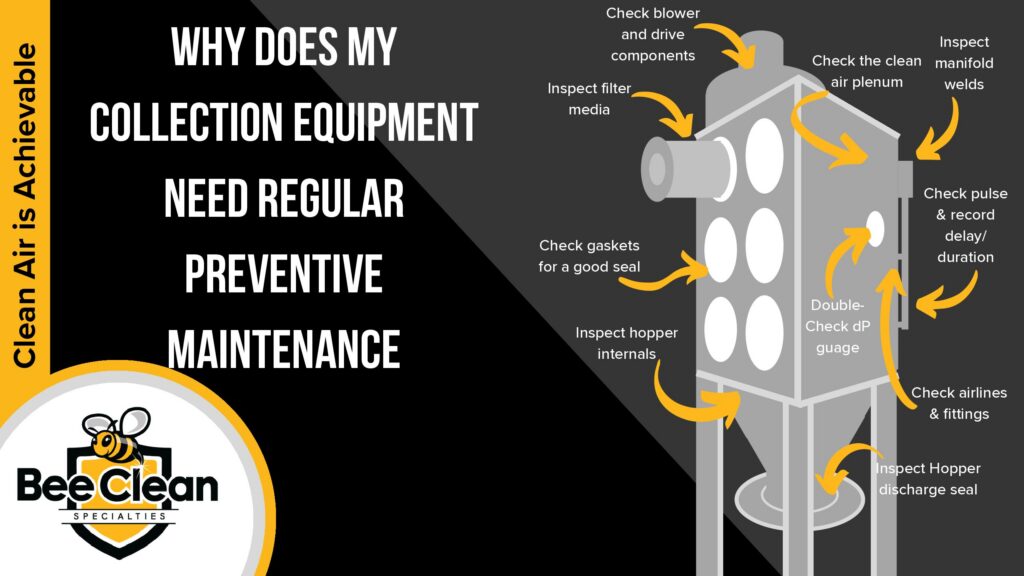
Some common maintenance tasks include:
- Filter inspections and replacement
- Fan and motor inspections
- Motor lubrication when required
- Seals and ductwork inspections
- Checking for duct leaks
- Monitoring differential pressure
- Removing collected dust
- Inspecting control panels and electrical components
- Checking dampers and other airflow controls for dirt buildup that may prevent correct operation
Some facilities may benefit from a daily quick walk-around inspection, reading of gauges and motor amperage, and logging of this information. Most systems require a monthly inspection, while other less critical applications require a quarterly maintenance schedule, which is sufficient. A more detailed inspection should also be performed periodically to evaluate the overall condition of the system. Any time the system is modified, it should be checked to be sure all parts of the system are still within design spec.
The specific maintenance requirements will vary depending on the equipment and application.
How Often Should Preventive Maintenance Be Performed?
There is no single maintenance schedule that works for every dust collection system. The appropriate frequency depends on the type of dust, pollutant concentration, operating hours, airflow requirements, and equipment design.
The important thing is to establish a maintenance schedule based on your equipment and process rather than waiting until something fails.
Don’t Wait for Failure
Preventive maintenance is one of the simplest ways to protect your equipment, your employees, your productivity, and your investment.
Dust collection systems may be out of sight, but they should never be out of mind. A system that is not properly maintained can lose airflow, become less effective, require expensive repairs, or contribute to safety concerns.
If you need help establishing a preventive maintenance schedule or evaluating your existing dust collection system, give us a call at 888.451.0844. We can help keep your air filtration equipment operating properly and your facility running smoothly.