
Understanding Particulate Matter (PM) Pollution in Manufacturing
What is particulate matter (PM) pollution in manufacturing, and why does it matter?
What is PM2.5 pollution?
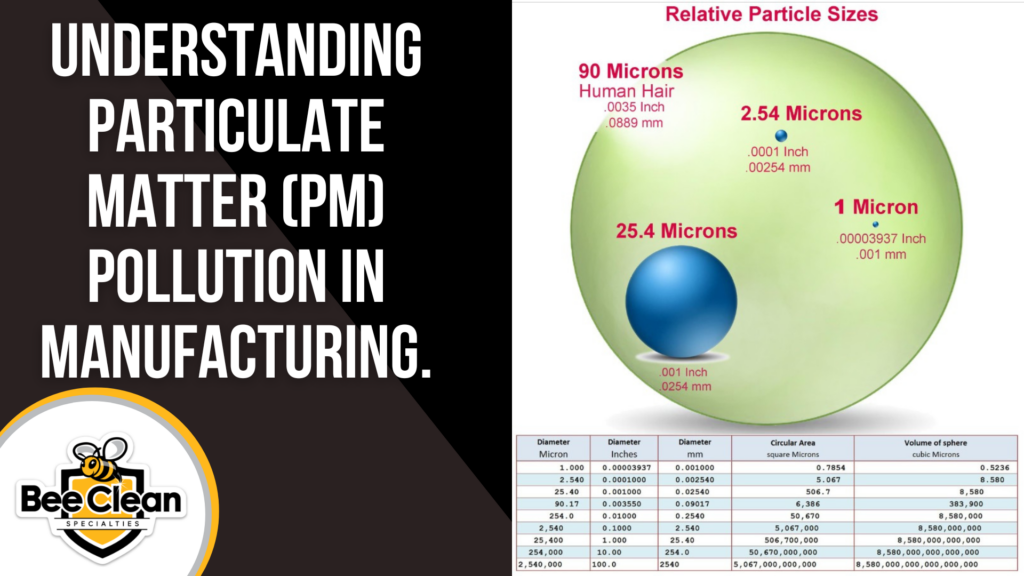
Particulate matter (PM) pollution is made up of solid or liquid particles suspended in the air. PM2.5 refers to airborne particles that are 2.5 microns in diameter and smaller. These emissions are common in manufacturing, construction, power generation, and even wildfires. In industrial settings, they can appear as smoke plumes or remain invisible without particle monitoring. Industrial smoke particles are often around 0.3 microns in diameter, making them difficult to capture without high-efficiency filtration.

In many facilities, air control systems such as SmogHog®, MistBuster®, Tri-Mist®, Trion®, Aerocology®, Aeroex®, and Donaldson Torit® are used to help capture and control these emissions.
Why PM pollution matters
PM exposure is dangerous because these ultrafine particles can reach deep into the lungs and even enter the bloodstream. Keep in mind that a red blood cell is larger than many of these particles. PM pollution can also impact operations by affecting equipment performance, increasing maintenance needs, and contaminating finished products.
How to control PM pollution
High-efficiency electrostatic air cleaning systems are among the most effective and energy-efficient solutions for manufacturing facilities. These systems can achieve up to 99.3% efficiency at submicron levels, capturing fine particles that may otherwise remain airborne for days without using much energy or requiring expensive disposable filters.
Bee Clean Specialties has over 40 years of experience helping manufacturers control particulate matter (PM) using systems such as SmogHog®, MistBuster®, Tri-Mist®, Trion®, Aerocology®, Aeroex®, and Donaldson Torit®. We evaluate existing systems, recommend improvements to maximize performance, and provide expert service to keep your equipment running at peak efficiency. Our service trucks are fully stocked with common replacement parts, motors, and blowers, allowing us to complete most repairs on-site and minimize downtime.